

Imagine you work in a pharmacy or warehouse where medicines requiring a constant temperature are stored in a refrigeration unit. You check the sensor readings and notice slight differences – one shows 8.0°C, another 8.5°C, and yet another 7.8°C. You wonder what is wrong – is it a sensor fault, or normal fluctuations, or perhaps you should report it to the supplier?
It turns out that such differences are completely natural and do not indicate a fault at all. In day-to-day work with refrigeration equipment and temperature and humidity monitoring systems, they can be observed quite frequently. That is why it is worth understanding the difference between accuracy and precision, what factors can influence measurement results, and how refrigeration equipment works. This article aims to help you interpret readings, even if you are not a specialist in metrology. Let’s get started!
Accuracy – is the reading close to the truth?
Measurement accuracy can be compared to shooting an arrow at a target. The centre of the target is the true value, and the point where the arrow hits the target is the measured value. The closer the arrow hits the centre, the more accurate the measurement. We can therefore describe accuracy as the degree to which a measurement corresponds to the true value.
A parameter closely related to accuracy is measurement error. We can visualise measurement error as successive concentric circles on the target – each subsequent circle is further from the centre of the target. The further the arrow lands from the centre of the target, the greater the error. The arrow may hit at the same distance from the centre point but below, above, to the left or to the right.
Measurement error can be expressed in two ways relative to the actual value:
absolutely, e.g. ±0.5°C,
relatively, e.g. 5% – this allows us to assess how significant the error is.
An absolute error of ±0.5°C for an actual temperature of +5°C is 10%, but for +100°C it is only 0.5%. Or as much as 0.5%, as measurement requirements depend on the technological process.
Example: the actual temperature inside a refrigeration unit is 5.0°C. If the sensor reads 5.1°C, it is very accurate. If it reads 7.0°C, the difference is significant and the measurement is inaccurate.
For those responsible for storing medicines, measurement accuracy means the certainty that the measured temperature is close to the actual temperature. In practice, values of this parameter at ±1.0°C for rooms and ±0.5°C for refrigeration units and freezers are considered acceptable.

Precision – are the measurements repeatable?
Precision, on the other hand, does not indicate whether the result is close to the actual value, but whether it is repeatable. Using the example mentioned earlier, you could have a sensor that always displays 7.0°C, even if the actual temperature is 5.0°C. The results are then highly repeatable – i.e. precise – but shifted from the actual value, i.e. inaccurate.
To summarise, using the analogy of a shooting target: accuracy is hitting the centre of the target, whilst precision is hitting the same point on the target. Ideally, a measuring instrument should be both precise and accurate, which ensures both the stability (precision) of the measurement and its conformity with reality (accuracy). In practice, there are no perfect measurement methods, which is why instruments have specified permissible measurement errors for ranges or measurement points.
Where do differences in measurements come from?
We have partly answered this question above: from the parameters of the measuring devices themselves, their accuracy, precision and permissible measurement error. If you have two thermometers that meet the requirements, measuring at +5°C with a permissible error of ±0.5°C, one might read +4.5°C and the other +5.5°C, and both readings would be correct!
In everyday use, there are many other factors that can affect measurement results. Firstly, reference devices – such as built-in sensors in refrigeration units or traditional thermometers – are often not calibrated, and their readings may be averaged or filtered. Such sensors are usually used to control the operation of the unit, rather than for precise measurement. These devices also have their own accuracy and precision.
Secondly, conditions in a cold room or chamber are never perfectly uniform, which is a consequence of the laws of physics. Air is constantly circulating: cooler air sinks, warmer air rises. The larger the volume of the unit or room, the greater the fluctuations may be.
Thirdly, the operation of the refrigeration unit causes natural temperature fluctuations. Refrigeration units may operate on an on/off basis or with smooth control (within a certain range) of their operation. Particularly in the former case, the unit switches on to cool the chamber of the refrigeration unit to a temperature below the set point, after which it switches off. When the temperature rises slightly above the set temperature, the unit switches on and the cycle repeats. In addition, a defrost cycle may occur, i.e. a temporary and controlled rise in temperature to remove frost from the heat exchanger component (e.g. the rear wall of the refrigeration unit).
The illustration below from the CoolSens system shows this phenomenon in a refrigeration unit operating in a pharmacy. The higher temperature spikes correspond to defrosting, whilst the lower ones indicate standard operation of the unit.
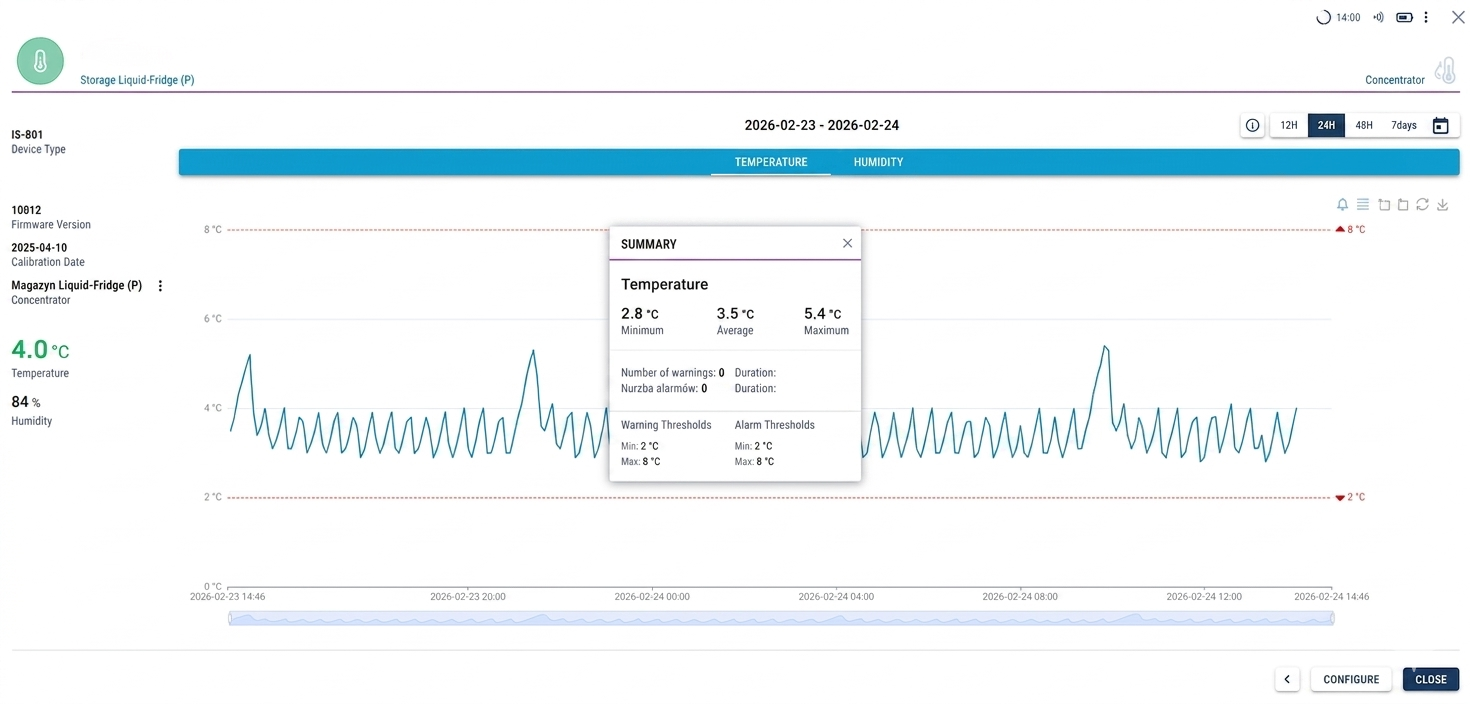
Fourthly, as we have already mentioned but not elaborated on, the cooling element is located, for example, on the rear panel of the unit and, in order to achieve the setpoint temperature inside the chamber, the cooling element must reach a temperature lower than the setpoint to compensate for energy losses (heating) resulting from the unit’s construction (imperfect insulation) or the opening of the door. The mechanism is analogous to that of a radiator, which heats the room to +22°C, but itself reaches, for example, as high as +55°C. Thanks to temperature averaging, ‘it seems to us’ that the room temperature is +22°C, although in reality there is a constant mixing of warm and cold air (or rather, warmer and cooler air), and the temperature gradient (distribution) throughout the room is significant.
Fifthly, design differences in the sensors – the type of sensor, its own weight, the housing (sealed or ventilated), the orientation of the ventilation grilles, and the response time (inertia) – affect how quickly the unit reacts to temperature changes.
All of this means that minor discrepancies are completely normal, and as long as they fall within the specified accuracy and precision, everything is fine.

What does this mean?
Firstly, the control of the refrigeration unit is not precise – differences of up to approximately 1.0°C in the built-in sensors are natural. Secondly, the CoolSens Node displays very stable (precise) results, varying by a maximum of 0.3°C, which is within the stated accuracy. Additionally, the CoolSens Node’s readings are slightly higher than those of other sensors, which may suggest that standard sensors slightly underestimate the temperature – rather than the CoolSens being inaccurate.
In practice, this means that CoolSens Node ensures the repeatability and accuracy of measurements, regardless of local fluctuations within the chamber.
CoolSens sensors – how we eliminate doubts
We now know where the differences in measured values come from, and why there are temperature spikes over time despite an apparently ‘constant temperature’, but we still do not know how to be certain that what we are measuring is the correct value. This is where high-quality suppliers of electronic components, accredited laboratories and controlled measurement environments come to the rescue.
CooSens sensors are digital, which makes them immune to various types of interference in analogue signals (e.g. resistance, voltage fluctuations), ensures a rapid response to changes in measured values, and they are manufactured in accordance with the ISO/IEC 17025 standard, which guarantees repeatability and controlled accuracy.
Furthermore, each CoolSens sensorCoolSens can be additionally calibrated in a laboratory accredited by the Polish Centre for Accreditation (PCA), with the results confirmed by a formal calibration certificate issued by an accredited and independent laboratory – a document clearly specifying the reference value and measurement uncertainty. Why is calibration so important? Because it is only in a controlled environment, with known and specified temperature and humidity, that one can verify how accurately and precisely the sensor measures. Highly accurate metrological instruments (ultra-thermostats) are used for this purpose, which are themselves calibrated against the readings of standards from other laboratories. Every device is subject to a certain measurement error, which is why it is essential to always carry out comparative measurements under controlled conditions and against a standard whose parameters are known.
In domestic or office environments, achieving such repeatability and conditions is very difficult, if not impossible, as we encounter the phenomena described earlier in this article. An example excerpt from the calibration certificate for the CoolSens Node sensor is provided below:

Thanks to the use of high-quality electronic components, Inventia Sp. z o.o.’s many years of experience in device design, and the calibration of devices by an independent accredited laboratory, the user can be confident that the readings are both stable and accurate.
FAQ – frequently asked questions
Do differences in readings indicate a problem with the sensor?
Not always. They may result from local conditions within the refrigeration unit, the installation location, or limitations of the reference devices.
Are traditional thermometers sufficient?
For day-to-day monitoring, yes, but their limited resolution and lack of calibration do not allow for full pharmaceutical control.
Does a digital sensor always show the true value?
No sensor is completely error-free, but calibrated digital sensors have a known, controlled measurement uncertainty and low inertia, which improves response time.
How often should a sensor be calibrated?
Usually once a year, although this depends on the regulatory requirements for the specific industry and the individual quality procedures at the facility in question. Calibration confirms the repeatability and accuracy of the measurement at the time the calibration test is performed.
This article shows that slight differences in readings are normal, and choosing a professional solution such as CoolSens gives you peace of mind and the certainty that temperature and humidity measurements are repeatable, precise and accurate.


